
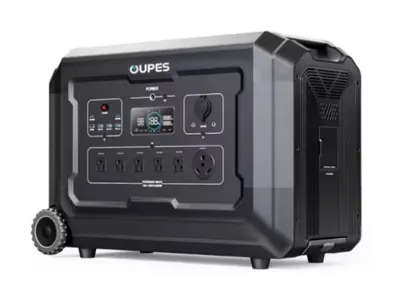
Oupes Mega 3
8.2 / 10 · Mid Range
Oupes Mega 3
The Oupes Mega 3 looks like a capable high-output power station with thoughtful portability and strong home backup potential, but its size, 120V-only output, and manual restart behavior matter before you buy.
Based on the available testing, the Oupes Mega 3 stands out for its 3600W pure sine wave inverter, expandable setup, solid output options, and unusually practical wheels and pull handle for a heavy unit. It also appears flexible for solar charging and basic home backup use. The main tradeoffs are its weight, lack of 240V output, and the fact that output functions do not automatically come back on after shutdown or battery depletion.
Watch Before You Buy
See how it actually performs

Best For
This is best for users who want reliable performance without jumping into ultra expensive systems.
Watch For
Limited expansion if your power needs grow significantly
Quick Decision
The fast answer most buyers actually want
This section is built to help you decide quickly whether this product fits your needs before you dig through the rest of the review.
Standout Feature
A high-output 3600W pure sine wave inverter paired with wheels and a pull handle that make a heavy unit easier to move than most in this class.
Biggest Tradeoff
It is still a heavy power station at over 82 pounds, and it remains a 120V-only unit despite its backup-oriented design.
Value Summary
The Mega 3 makes the most sense for buyers who want serious 120V backup power, solar input flexibility, and better-than-average portability for a large unit. It looks less compelling if you need true lightweight portability or native 240V output.
Use Case Fit
Where this product fits best in real life
This section helps you quickly map the product to real scenarios so you can tell whether it fits your situation or whether you should be looking at something else.
Home backup for essential 120V circuits
Excellent FitA strong match for running selected household loads through a transfer switch, as long as the loads stay within the unit's 120V and 3600W output limits.
RV or mobile power with higher output needs
Good FitThe outlet selection and 30A connection make it look useful for RV-style use, especially if you want a portable backup source and app control, but weight is still a factor.
Frequent grab-and-go portable use
Situational FitThe wheels and suitcase-style handle help a lot, but at more than 82 pounds this is still better described as movable than easy to carry around regularly.
Buying Options
Oupes Mega 3
Choose the best buying path based on how you like to shop
Scorecard
How this product stacks up where it actually matters
This scorecard gives a faster read on the categories most buyers care about so you can spot the strengths and tradeoffs without digging through every section first.
Power Output
0.0 / 10
A 3600W pure sine wave inverter and multiple 20A outlets give it serious 120V capability for backup and appliance use.
Portability
0.0 / 10
It is heavy, but the built-in wheels and pull handle make it easier to move than many large power stations.
Charging Flexibility
0.0 / 10
Solar input, AC input, and the ability to combine them make it look flexible for different charging situations.
Ease of Ownership
0.0 / 10
The controls and app support are useful, but manual reactivation of outputs and wireless features after shutdown is a real convenience drawback.
Pricing Intelligence
Value depends on whether you need large 120V backup power
For buyers who will actually use the inverter capacity, solar input, and expansion options, this kind of power station can justify a higher price than smaller units. If you only need light charging or occasional device power, much of what makes the Mega 3 interesting may go unused.
Buying Insight
Makes more sense if you need real inverter power
Buyers who need to run meaningful household or RV loads are more likely to see the value here than buyers just charging phones and laptops.
Buying Insight
Portability adds practical value
For a unit this heavy, wheels and a pull handle are not small extras. They meaningfully change how realistic it is to move and use.
Buying Insight
Compare against your voltage needs first
If your setup depends on native 240V output, this may not be the right fit no matter how good the rest of the package looks.
Amazon Path
Usually best for speed, easy checkout, and familiar returns.
Brand Store Path
Usually best when direct support, bundles, or direct promos matter more.
How I Test
Real-world power station testing
This draft focuses on practical use: output quality, charging behavior, portability, outlet layout, and backup usefulness. The goal is to judge how the unit fits real buyers, not just repeat a spec sheet.
Test Focus
Inverter waveform verification
The AC output was checked with an oscilloscope to confirm that the inverter was producing a true pure sine wave rather than relying on brand claims alone.
Test Focus
Solar and AC charging observation
Charging behavior was tested with a real solar array and also with combined solar plus AC input to see how the unit handles faster recharge scenarios.
Test Focus
Practical backup and outlet review
The unit's outlet layout, transfer-switch compatibility, app setup, restart behavior, and overall usability were evaluated from the perspective of real ownership.
Technical Details
Key specs that matter early in the buying decision
This section belongs near the top because serious buyers often want to sanity check the core specs before they commit more time.
Weight
82.4 pounds
AC Inverter Output
3600W pure sine wave
AC Output Voltage
120V
Solar MPPT Range
12V to 150V
What I liked
Verified pure sine wave AC output
Strong 3600W 120V inverter for serious loads
Wheels and pull handle improve portability
Can charge from solar and AC at the same time
Supports expansion battery connection
What gave me pause
Heavy at over 82 pounds
120V only, not a native 240V solution
Outputs and wireless control do not automatically restore after shutdown
Outlet orientation may not be everyone's preference
Questions that matter before and after the click
This section is split intentionally so buyers can either validate the purchase decision or dig deeper into real world ownership questions.
It is portable in the sense that it has wheels and a pull handle, which help a lot, but it still weighs 82.4 pounds. For most buyers, this is more of a rollable power station than something you will want to carry often.
It appears suitable for powering essential 120V loads through a transfer switch, as long as your setup and adapter are compatible and you stay within the 3600W output limit. It is not a native 240V power station.
It appears to support substantial solar input, and the review also shows that AC and solar can be combined for faster charging. Actual results will still depend on your panel setup and weather.
No. Based on the review, after powering the unit back on you need to manually turn the desired output sections back on, and that also includes wireless control functions.
The review checked the inverter output with an oscilloscope and concluded that it was a true pure sine wave. That is a good sign for electronics that prefer clean AC power.
You still need to pay attention to the correct input port and stay within the stated voltage range. The review specifically warns not to plug solar into the 12V 30A output, so basic setup awareness is important.
Should you buy the Oupes Mega 3?
The Oupes Mega 3 appears to be a practical large-capacity power station for buyers who want strong 120V output, solar charging flexibility, and home or RV backup potential without stepping into a full 240V system. It looks well thought out in a few important ways, especially portability for its size, but you should go in knowing that it is still heavy and that some power recovery behavior is more manual than ideal.