
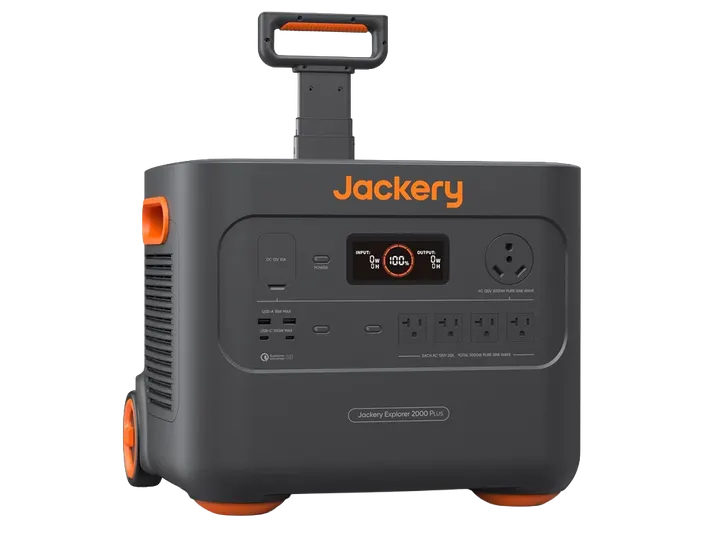
Jackery Explorer 2000 Plus
8.2 / 10 · Premium
Jackery Explorer 2000 Plus
The Jackery Explorer 2000 Plus looks strongest as a high-output expandable backup power station for buyers who care more about real inverter performance and circuit compatibility than compact design or premium build feel.
This is a 3000W portable power station with expandable battery capacity, solid inverter efficiency, and useful home backup potential through a transfer switch. The main strengths here are output, expandability, and compatibility with dual function breakers. The main downsides are the less convincing handle and top-panel build quality, plus a rear port layout that can make placement and cable management less convenient.
Watch Before You Buy
See how it actually performs

Best For
This is best for users who want reliable performance without jumping into ultra expensive systems.
Watch For
Limited expansion if your power needs grow significantly
Quick Decision
The fast answer most buyers actually want
This section is built to help you decide quickly whether this product fits your needs before you dig through the rest of the review.
Standout Feature
Strong real-world inverter performance with expandable capacity and home backup flexibility.
Biggest Tradeoff
The performance is strong, but the physical design and build details feel less refined than they should at this level.
Value Summary
The Explorer 2000 Plus makes the most sense for buyers who want a serious backup-ready power station with 3000W output and room to expand over time. It offers real capability, but the value depends on whether you will actually use the expandability and home backup features enough to justify the size, cost, and setup complexity.
Use Case Fit
Where this product fits best in real life
This section helps you quickly map the product to real scenarios so you can tell whether it fits your situation or whether you should be looking at something else.
Home backup through a transfer switch
Excellent FitThis appears well suited for buyers who want to support multiple 120V household circuits and care about compatibility with dual function breakers.
Expandable backup system for longer outages
Good FitThe expandable battery design is useful for buyers planning to grow capacity over time, though the added wiring and placement demands should be considered.
Simple portable power for occasional light use
Situational FitIt can handle this, but the size, complexity, and likely cost make it harder to justify if you do not need the high output or expansion options.
Buying Options
Jackery Explorer 2000 Plus
Choose the best buying path based on how you like to shop
Scorecard
How this product stacks up where it actually matters
This scorecard gives a faster read on the categories most buyers care about so you can spot the strengths and tradeoffs without digging through every section first.
Power Output
0.0 / 10
The 3000W inverter appears to perform as claimed, which is a major strength for backup use.
Expandability
0.0 / 10
The ability to add batteries and even parallel units gives it meaningful long-term flexibility.
Build and Design
0.0 / 10
The reviewer called out concerns with the handles, top construction, and rear port layout.
Home Backup Practicality
0.0 / 10
It looks especially useful for 120V backup setups, though space, wiring, and solar expansion complexity matter.
Pricing Intelligence
Worth considering if you need output and expansion, not just portable battery power
This looks easier to justify for backup-focused buyers than for casual users. If you only need occasional charging or light portable use, its bigger strengths may go underused. If you plan to run home circuits, expand capacity, or replace some generator use, the higher cost may make more sense.
Buying Insight
Best value if you will actually use the 3000W output
Buyers who only need light charging or small appliance support may be paying for capability they will not use.
Buying Insight
Expansion adds capability but also system complexity
The expandable design is useful, but the total ownership picture can include more cables, more space, and more solar setup planning.
Buying Insight
Consider installation costs if buying for home backup
If your goal is a transfer switch or more permanent solar charging setup, the product price may be only part of the total cost.
Amazon Path
Usually best for speed, easy checkout, and familiar returns.
How I Test
Real Backup Testing Over Spec Sheet Hype
This draft focuses on how the unit works in realistic ownership scenarios: powering household circuits, handling sustained loads, integrating with transfer switches, and showing where design compromises matter in daily use.
Test Focus
Sustained inverter load testing
The reviewer checked whether the unit could hold its rated 3000W continuous output in actual use rather than relying on marketing claims.
Test Focus
Usable capacity and efficiency check
Battery output was measured against stated capacity to estimate inverter efficiency and get a more practical picture of what buyers can really use.
Test Focus
Transfer switch and household circuit compatibility review
The unit was evaluated in a home backup context, including powering multiple 120V circuits and checking compatibility with dual function breakers.
Technical Details
Key specs that matter early in the buying decision
This section belongs near the top because serious buyers often want to sanity check the core specs before they commit more time.
Inverter Output
3000W pure sine wave
Battery Capacity
2042.8Wh
AC Outlets
4 x 120V AC outlets plus RV-style plug
Solar Input
Up to 1400W total via 2 MPPTs, 60V and 12A max each
What I liked
Strong 3000W continuous output
Good measured inverter efficiency in the review
Expandable battery system for larger backup needs
Compatible with dual function breakers
Useful fit for transfer switch based 120V backup
What gave me pause
Handle quality appears underwhelming
Top design feels less robust than some buyers may want
Rear port layout makes wall placement less convenient
Solar expansion can add setup cost and complexity
Questions that matter before and after the click
This section is split intentionally so buyers can either validate the purchase decision or dig deeper into real world ownership questions.
It looks like a good fit if you want to back up multiple 120V circuits and use a transfer switch. It is less ideal if you need 240V backup or want the simplest possible plug-and-play setup.
Yes, expandability is one of its stronger selling points. That said, adding batteries and solar can also increase cable management, space demands, and installation complexity.
Based on the transcript, performance seems strong, but some physical details do not impress as much. The handles and top construction were specifically mentioned as weaker points.
The reviewer reported getting 1869Wh from the stated 2042.8Wh capacity, which was estimated at about 91.2% efficiency. That is a strong result if your use case depends on getting as much usable energy as possible.
That appears to be one of its practical strengths. The review specifically discussed powering multiple 120V circuits and noted compatibility with dual function breakers, which can matter in newer homes.
Not in every way. The wheels and pull handle help with movement, but the reviewer was not impressed by handle quality, and the rear-facing ports can make placement against a wall less convenient.
Should you buy the Jackery Explorer 2000 Plus?
If your priority is dependable 120V backup power, strong inverter output, and the option to grow into a larger system, the Jackery Explorer 2000 Plus looks like a capable choice. If you care more about compact storage, cleaner cable routing, or sturdier fit and finish, there are some design tradeoffs here that are hard to ignore.