
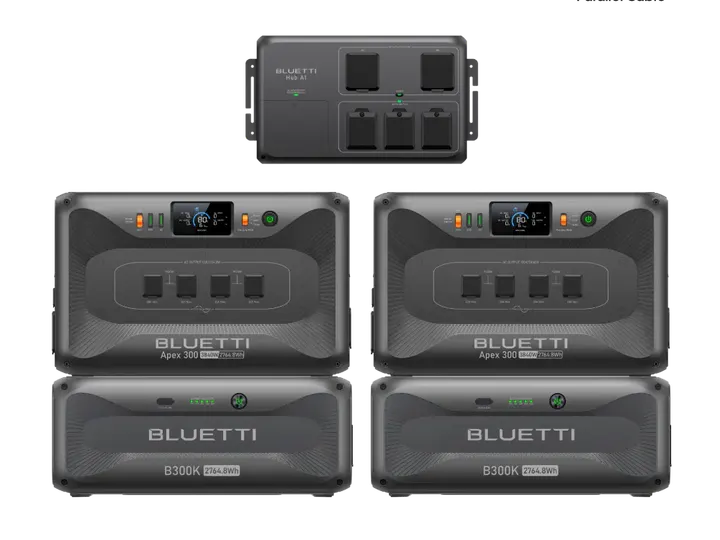
Bluetti Apex 300
9.1 / 10 · Premium
Bluetti Apex 300
The Bluetti Apex 300 looks like a very flexible high-capacity backup platform for buyers who want modular home backup and 120V/240V output from a single unit, but its size, weight, and likely higher cost make it a more specialized buy than a casual portable power station.
The Apex 300 stands out for combining single-unit 120V and 240V output, strong expansion potential, and several charging options in a modular system aimed at serious backup use. Based on the source material, it appears especially appealing for home backup, DIY solar users, and buyers who want room to scale. The main tradeoff is that this is a heavy, complex, premium system that makes more sense for planned backup power than grab-and-go portability.
Brand Store Coupon
Use this at checkout on the brand site
Watch Before You Buy
See how it actually performs

Best For
This is best for users who want reliable performance without jumping into ultra expensive systems.
Watch For
Limited expansion if your power needs grow significantly
Quick Decision
The fast answer most buyers actually want
This section is built to help you decide quickly whether this product fits your needs before you dig through the rest of the review.
Standout Feature
Single-unit 120V and 240V output with substantial modular expansion for larger backup setups.
Biggest Tradeoff
It is heavy and system-oriented, so it is far less convenient than smaller portable power stations.
Value Summary
This system makes the most sense for buyers who want flexible backup power that can start as one unit and grow into a much larger home energy setup. The value is in expandability and output flexibility, not lightweight portability.
Use Case Fit
Where this product fits best in real life
This section helps you quickly map the product to real scenarios so you can tell whether it fits your situation or whether you should be looking at something else.
DIY home backup with room to expand
Excellent FitThis looks like a strong fit for buyers building a flexible backup system who may want to start with one unit and expand with extra batteries or parallel units later.
RV or van owners with high power needs
Excellent FitIt can make sense for mobile users who need substantial power capacity and multiple charging methods, but the weight and size are important compromises.
Occasional emergency backup for basic devices only
Situational FitIf you only want to keep a few essentials running during short outages, this may be more expensive, heavier, and more capable than necessary.
Buying Options
Bluetti Apex 300
Choose the best buying path based on how you like to shop
Brand Store Coupon
Use this at checkout on the brand site
Scorecard
How this product stacks up where it actually matters
This scorecard gives a faster read on the categories most buyers care about so you can spot the strengths and tradeoffs without digging through every section first.
Power Flexibility
0.0 / 10
Single-unit 120V and 240V output is a meaningful advantage for more serious backup use.
Expandability
0.0 / 10
The modular design and support for parallel units and external batteries give it unusually broad scaling potential.
Portability
0.0 / 10
It is technically portable, but the reviewed weight makes it much less convenient than smaller power stations.
Buyer Accessibility
0.0 / 10
The feature set is strong, but this product is easier to justify for informed buyers with a real backup plan than for beginners shopping casually.
Pricing Intelligence
Best judged as a system investment, not a casual power station purchase
The buying logic here is less about getting the cheapest battery box and more about whether you will actually use the modular backup features, 240V support, and expansion path. If you only need occasional small-device backup, this may be more system than you need.
Buying Insight
Pay for the expansion path only if you will use it
A major part of the appeal is the ability to scale up. If you do not expect to expand beyond basic backup, a simpler model may offer better value.
Buying Insight
Weight and setup should factor into value
The system may offer strong capability, but that value drops if you need something easy to move often or deploy quickly by one person.
Buying Insight
Compare against fixed backup goals, not just headline specs
Think about what loads you actually need to run and whether single-unit 240V output or larger battery expansion changes the decision meaningfully.
Amazon Path
Usually best for speed, easy checkout, and familiar returns.
Brand Store Path
Usually best when direct support, bundles, or direct promos matter more.
Live Coupon
Current code: SOLARPIT05
How I Test
Real Backup Power Matters More Than Spec Sheet Hype
For a product like this, useful testing means looking at real backup use, charging flexibility, system expansion, noise, handling, and practical tradeoffs rather than repeating brand claims. Buyers need to know how it fits actual home or mobile power needs.
Test Focus
Output and backup scenario testing
Evaluate how the unit handles realistic household loads, including whether its 120V and 240V output flexibility is genuinely useful in a home backup setup.
Test Focus
Charging flexibility checks
Compare practical charging methods such as wall input, solar, generator input, and other supported charging options to see which ones are most useful in real ownership.
Test Focus
Handling, noise, and setup evaluation
Assess how manageable the unit is to move, how loud it gets during charging and output use, and how practical the modular system feels to set up.
Technical Details
Key specs that matter early in the buying decision
This section belongs near the top because serious buyers often want to sanity check the core specs before they commit more time.
Inverter Output
3,840W pure sine wave
Internal Battery Capacity
2,764.8Wh
Weight
83.2 lb
Warranty
5 years
What I liked
Single unit provides both 120V and 240V output
Strong modular expansion options for larger backup systems
Multiple charging methods supported
LFP battery chemistry with long stated cycle life
Well suited to serious home backup planning
What gave me pause
Heavy for a product described as portable
Likely overkill for buyers with basic backup needs
Modular setup is more complex than an all-in-one casual solution
Questions that matter before and after the click
This section is split intentionally so buyers can either validate the purchase decision or dig deeper into real world ownership questions.
It appears best suited for buyers who want flexible backup power with room to expand, especially for home backup, DIY solar planning, or higher-demand RV use. It makes less sense for someone who only needs a small emergency battery.
Probably only in specific cases. The Apex 300 is heavy and built around bigger backup potential, so buyers focused on easy carrying and simple occasional use may be better served by a smaller unit.
Yes, based on the source material, expansion is one of its key selling points. It supports external batteries and parallel operation, which is a major reason someone would choose this over a simpler power station.
Not especially portable in the casual sense. The unit is heavy enough that moving it regularly will matter, particularly for stairs, vehicle loading, or overhead lifting.
That appears to be one of its strongest use cases. The combination of 120V and 240V output, expansion support, and backup-focused features makes it more home-backup oriented than many smaller power stations.
The biggest tradeoff is managing a larger, heavier, more system-like product. In exchange for added flexibility and output, you give up some convenience, simplicity, and likely budget friendliness.
Should you buy the Bluetti Apex 300?
If you want a scalable backup platform with serious output potential and single-unit 120V/240V capability, the Bluetti Apex 300 looks promising on paper and in early overview coverage. If your priorities are light weight, simplicity, or lower upfront cost, this is probably not the right fit.
Brand Store Coupon
Use this at checkout on the brand site