
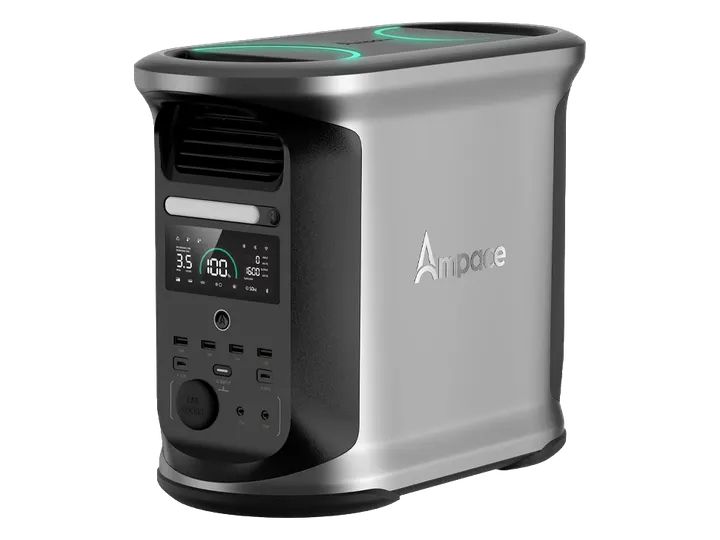
Ampace Andes 1500
8.2 / 10 · Mid Range
Ampace Andes 1500
The Ampace Andes 1500 looks like a strong all-around portable power station with excellent real-world efficiency, quiet operation, and useful output capacity, though a few app and charging limitations are worth knowing before you buy.
Based on the transcript, the Andes 1500 stands out for unusually strong inverter efficiency, fast AC charging, quiet fan behavior, and a solid feature set for backup or portable use. It also appears well built and thoughtfully designed. The main tradeoffs are modest solar input for a system with expansion potential, a reported app communication issue in Wi-Fi mode, and some behavior under overload that may matter for sensitive equipment.
Watch Before You Buy
See how it actually performs

Best For
This is best for users who want reliable performance without jumping into ultra expensive systems.
Watch For
Limited expansion if your power needs grow significantly
Quick Decision
The fast answer most buyers actually want
This section is built to help you decide quickly whether this product fits your needs before you dig through the rest of the review.
Standout Feature
Very high real-world inverter efficiency paired with quiet operation.
Biggest Tradeoff
The 600W solar input may feel limiting, especially if you plan to expand battery capacity later.
Value Summary
For buyers who want a portable power station that balances usable capacity, strong AC output, fast wall charging, and quiet indoor-friendly performance, the Andes 1500 appears to offer solid value. It makes the most sense for people who care more about efficient real-world performance than headline specs alone.
Use Case Fit
Where this product fits best in real life
This section helps you quickly map the product to real scenarios so you can tell whether it fits your situation or whether you should be looking at something else.
Home backup for essentials and short outages
Excellent FitThe UPS function, quiet operation, strong AC output, and efficient battery use make it look well suited for keeping key devices and household essentials running during outages.
Indoor portable power where noise matters
Excellent FitThe transcript highlights very quiet operation both at lighter loads and even while charging hard, which makes it a practical choice for apartments, offices, RV interiors, or shared spaces.
Solar-focused expanded battery setups
Situational FitIt supports solar charging and battery expansion, but the stated 600W solar input may feel modest if you plan to scale storage significantly and want faster solar recovery.
Buying Options
Ampace Andes 1500
Choose the best buying path based on how you like to shop
Scorecard
How this product stacks up where it actually matters
This scorecard gives a faster read on the categories most buyers care about so you can spot the strengths and tradeoffs without digging through every section first.
Power Efficiency
0.0 / 10
The reported inverter efficiency was unusually strong in testing, with charging efficiency also coming in at a very good level.
Noise Control
0.0 / 10
The unit appears especially quiet in normal use and still reasonably quiet even during high-rate AC charging.
Features and Expandability
0.0 / 10
It offers a useful mix of outputs, UPS support, app control, and battery expansion, though solar input may be a limiting factor for larger setups.
App and Edge-Case Behavior
0.0 / 10
The app seems easy to use, but the reported Wi-Fi monitoring issue and voltage drop behavior under overload keep this from scoring higher.
Pricing Intelligence
Worth considering if efficiency and quiet use matter to you
Without confirmed pricing context, the buying case here rests on performance rather than bargain positioning. If current pricing is competitive with other 1.5kWh-class power stations, the strong efficiency, fast AC charging, and quiet operation could justify it. If priced high, buyers should weigh the limited solar input and minor app issues more carefully.
Buying Insight
Judge it on usable output, not just battery size
If the test figures hold up, the Andes 1500 may deliver more practical value than some competitors with similar rated capacity but weaker efficiency.
Buying Insight
Expansion plans change the value equation
If you intend to add expansion batteries, make sure the 600W solar input still matches how you plan to recharge the system in real use.
Buying Insight
Good fit if fast wall charging matters
Buyers who mostly recharge from AC may see more value here than buyers who expect solar to do most of the work.
Amazon Path
Usually best for speed, easy checkout, and familiar returns.
How I Test
Real-world performance matters more than spec sheets
This draft prioritizes practical results like usable battery output, charging efficiency, noise, overload behavior, and day-to-day usability. The goal is to highlight where the product performs well, where it falls short, and who will actually benefit from it.
Test Focus
Full-capacity discharge near rated output
The unit was discharged from 100% to 0% at a load close to its 2400W continuous rating to check stability and whether it could sustain heavy output without issue.
Test Focus
Usable capacity and charging efficiency checks
The reviewer measured how much energy could actually be delivered from the battery and how much wall power was required to recharge it, which gives a more useful picture than rated capacity alone.
Test Focus
Noise and real-use feature evaluation
Fan noise, charging behavior, UPS function, app use, and overload behavior were all examined to see how the product performs in everyday ownership rather than just on paper.
Technical Details
Key specs that matter early in the buying decision
This section belongs near the top because serious buyers often want to sanity check the core specs before they commit more time.
Battery Capacity
1462Wh
Continuous AC Output
2400W
Weight
36.6 lb
Warranty
5 years
What I liked
Excellent tested inverter efficiency
Very quiet in normal use
Fast AC charging
Good output selection for mixed devices
Thoughtful physical design with dual handles
What gave me pause
600W solar input may feel limited for expanded setups
Reported app monitoring issue in Wi-Fi mode
Voltage drop behavior when overloaded
Ambient lights cannot be turned off while charging
Questions that matter before and after the click
This section is split intentionally so buyers can either validate the purchase decision or dig deeper into real world ownership questions.
It appears to be a solid fit for backup of common household essentials thanks to its 2400W continuous output, UPS function, and quiet operation. Buyers should still confirm their actual wattage needs, especially if they plan to run multiple appliances at once.
The transcript reports very strong usable output and charging efficiency results, which is one of the main reasons this unit stands out. That matters because it affects how much of the rated battery capacity you can realistically use.
Possibly. The stated 600W solar input may be fine for the base unit in decent conditions, but it could feel slower than expected if you add expansion batteries or rely heavily on solar for recovery.
Based on the transcript, yes. It was described as virtually silent under lighter loads and still reasonably quiet even during high-rate charging, which makes it more indoor-friendly than many larger power stations.
Mostly, but with one important caution. The reviewer noted a Wi-Fi mode reporting issue where AC output values appeared incorrect even though the power station itself was not behaving that way. That sounds more like an app communication issue than a hardware problem, but it is still worth knowing.
The unit reportedly handled discharge near its rated continuous output without trouble, but under overload conditions the voltage dropped to maintain the load. Most typical users staying within the rated output likely will not encounter this, but it could matter for sensitive equipment or poor load planning.
Should you buy the Ampace Andes 1500?
The Ampace Andes 1500 comes across as a well-rounded power station with some genuinely impressive test results, especially in inverter efficiency and low noise. It looks like a good fit for home backup, general portable use, and buyers who want a refined-feeling unit without obvious major flaws. The main reasons to hesitate are if you need heavier solar charging, rely heavily on app monitoring, or expect to push sensitive loads near the top of its output range.